Lab 2: Tag Inventory Trace
Lab 2: Tag Inventory Trace
Lab 2: Tag Inventory Trace
Collect a trace for each scenario. Keep both raw observations and the middleware event output when your tooling allows it. Raw reads explain RF behavior; middleware output explains what the application actually sees.
Minimum trace fields:
run_id: unique identifier for the test run.tag_id: EPC, UID, or other tag identifier used by the reader.timestamp: reader-side or gateway-side event time.antenna_id: antenna or port that observed the tag.signal: RSSI, phase, read count, or the closest signal indicator your reader exposes.scenario: controlled test condition such as baseline, rotated tag, metal backing, dense group, or boundary tag.middleware_event: state such as first_seen, still_present, departed, duplicate_suppressed, missed_expected, or stray_read.
run_id: shelf-A-baseline-003
scenario: expected tags present
reader_config: reader_profile_shelf_A_v2
tag_id: asset-014
antenna_id: left-shelf
timestamp: 2026-06-18T09:14:22Z
signal: recorded by reader as reported
middleware_event: first_seen
operator_note: tag flat on plastic tray, no boundary tag detected
Do not edit the trace to make it look cleaner. If the reader produces duplicate observations, keep them and let the analysis show whether middleware suppressed them correctly.
To turn that trace into diagnoses, inspect Figure 1 from the expected population through each exception class. The point is to preserve how a raw observation was classified, not merely to count how many lines the reader emitted.
Figure 1 separates present, duplicate, stray, and absent tags.
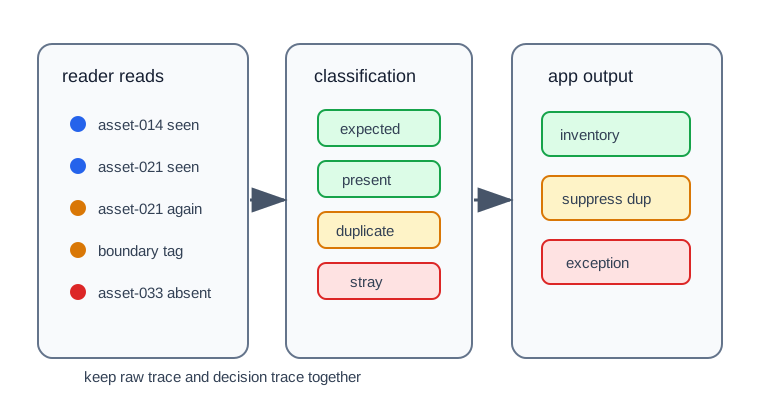
The reader observes asset-014 and asset-021, then sees asset-021 again. A boundary tag appears even though it should be outside the intended zone, while asset-033 is absent from the trace. Classification should retain those four different facts before middleware produces an inventory view. Duplicate suppression may keep one present asset, but it must not silently erase a stray read or turn an absent expected tag into a pass. Compare the raw observations with the filtered decision and expected asset list. That pair of traces shows whether the read zone and event rule both worked.
Read Figure 1 by establishing the expected identities first. A missing expected identity becomes a missed read; repeated observations of one identity become duplicate evidence to suppress or group; and an identity from outside the intended set becomes a stray read. Follow each branch to its middleware outcome and retained context. This classification prepares the replay step below, where rates and decisions are calculated against fixed target and boundary denominators.