Production case studies: figure review activities
Production case studies: figure review activities
The chapter needs visual evidence for prototype to fleet scale-up. Figure 1 provides it: Prototype to fleet scale-up case. Examine Pilot together with pause/rollback.

Interrogate Pilot first, then find pause/rollback in Figure 1. Apply the pause/rollback review question before not guessing. Those answers support prototype to fleet scale-up; the figure states: Prototype to fleet scale-up case.
Why pause at update and identity lifecycle? Beside OTA Firmware Update Lifecycle, the diagram Figure 2 makes (after 3 attempts) explicit within this relationship: OTA Firmware Update Lifecycle.

Interrogate OTA Firmware Update Lifecycle first, then find (after 3 attempts) in Figure 2. Apply the (after 3 attempts) review question before Old FW fallback. Those answers support update and identity lifecycle; the figure states: OTA Firmware Update Lifecycle.
Before approving observability and incident learning, test the depicted proposition in Figure 3: Observability and incident case. Read from Device toward Triage.
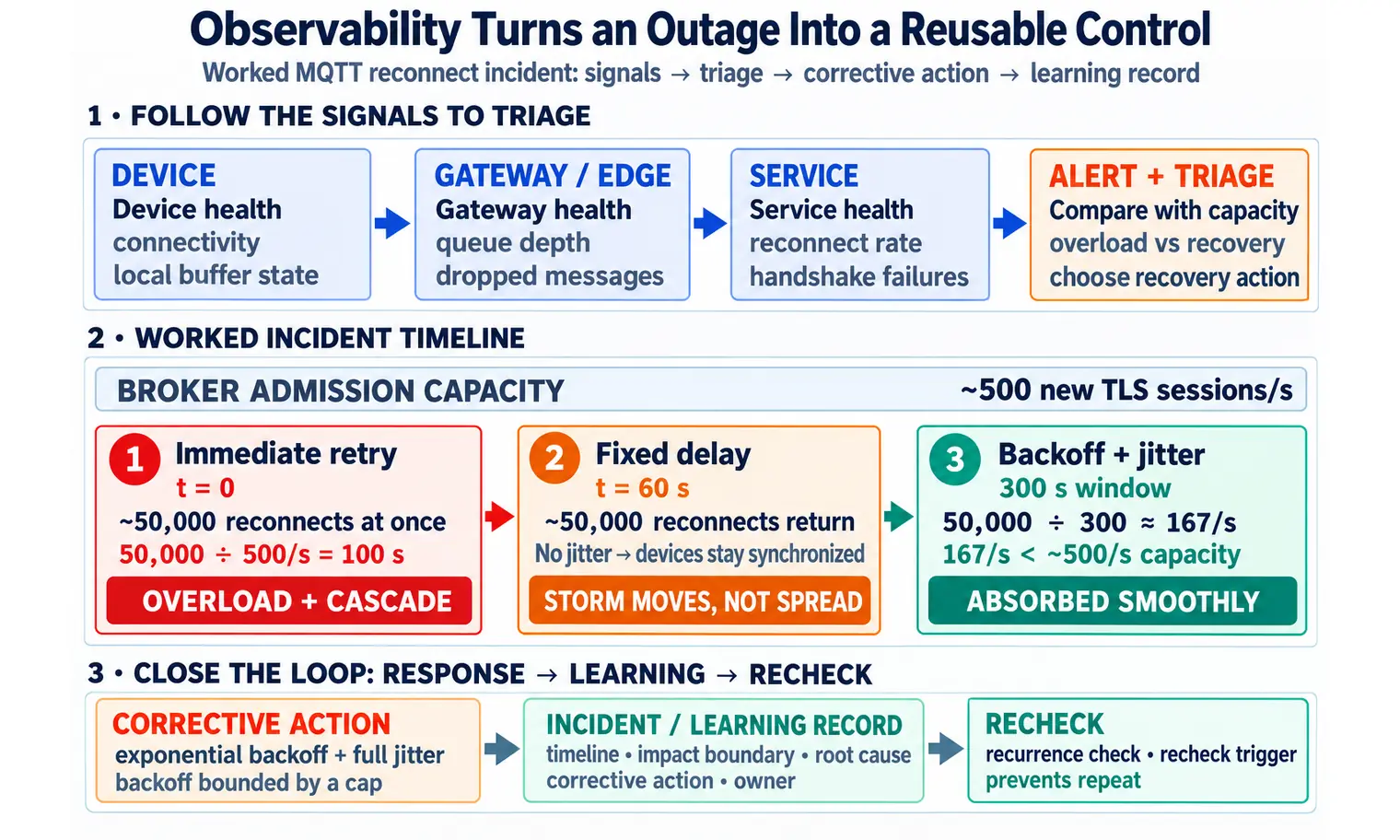
Before making the decision in this section, inspect Figure 4. It makes the decision concrete by showing production case study record, so the relationships can be checked before they are turned into a design claim.

Before making the decision in this section, inspect Figure 5. It makes the decision concrete by showing read the production case as a decision loop: context and consequence define the risk, evidence justifies the architecture decision, and the record assigns the next review or action, so the relationships can be checked before they are turned into a design claim.

Technical boundaries. These figure-review prompts use one illustrative production fleet; they train evidence-reading habits, and no fleet size, rollout rate or support cost shown here is a measured result.